




Spec sheet
LFP-150 datasheet
Full electrical, BMS, thermal & chemical-safety data — the same numbers our engineers test to.
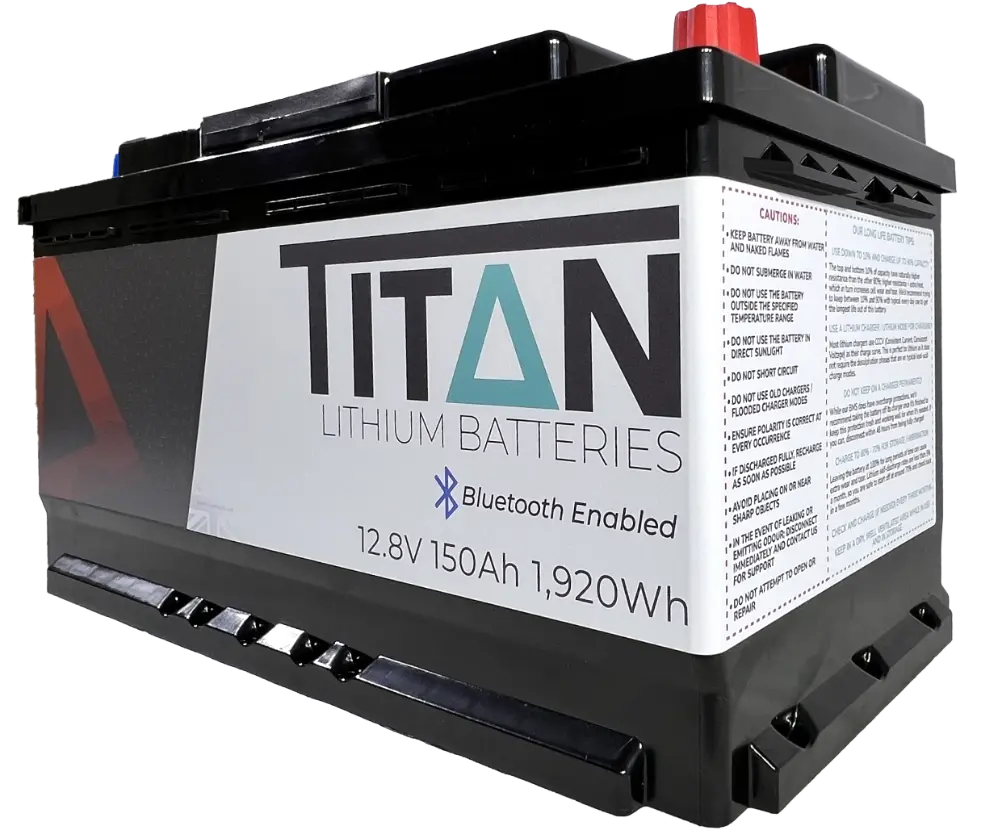
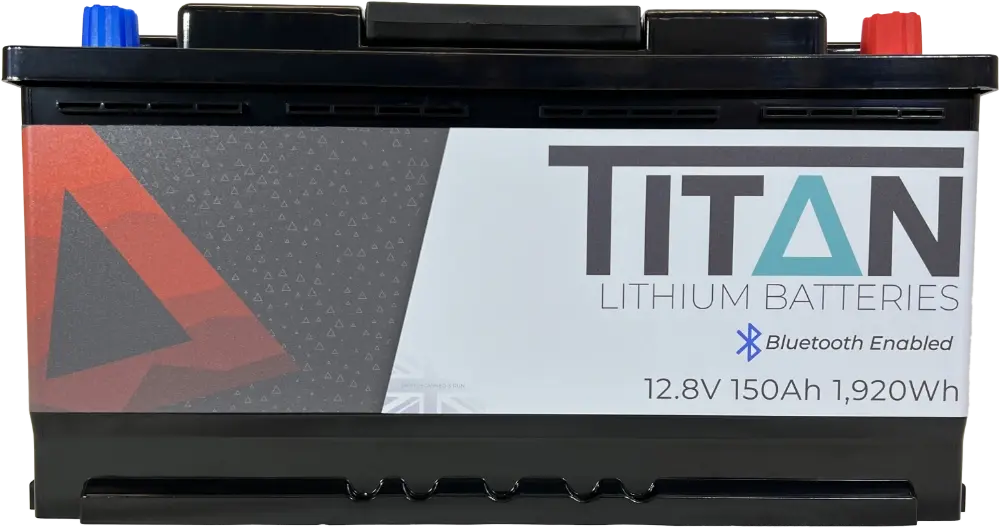
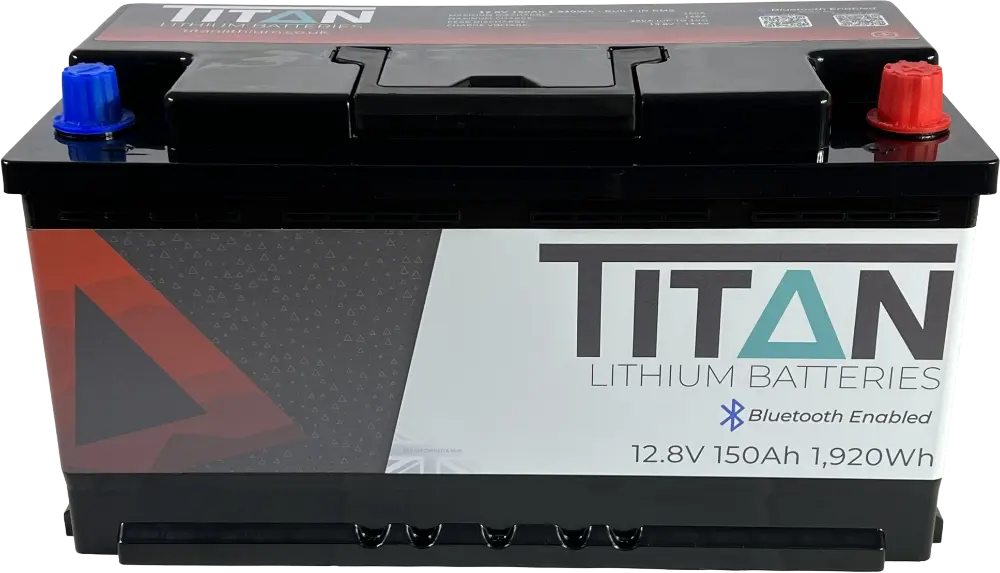
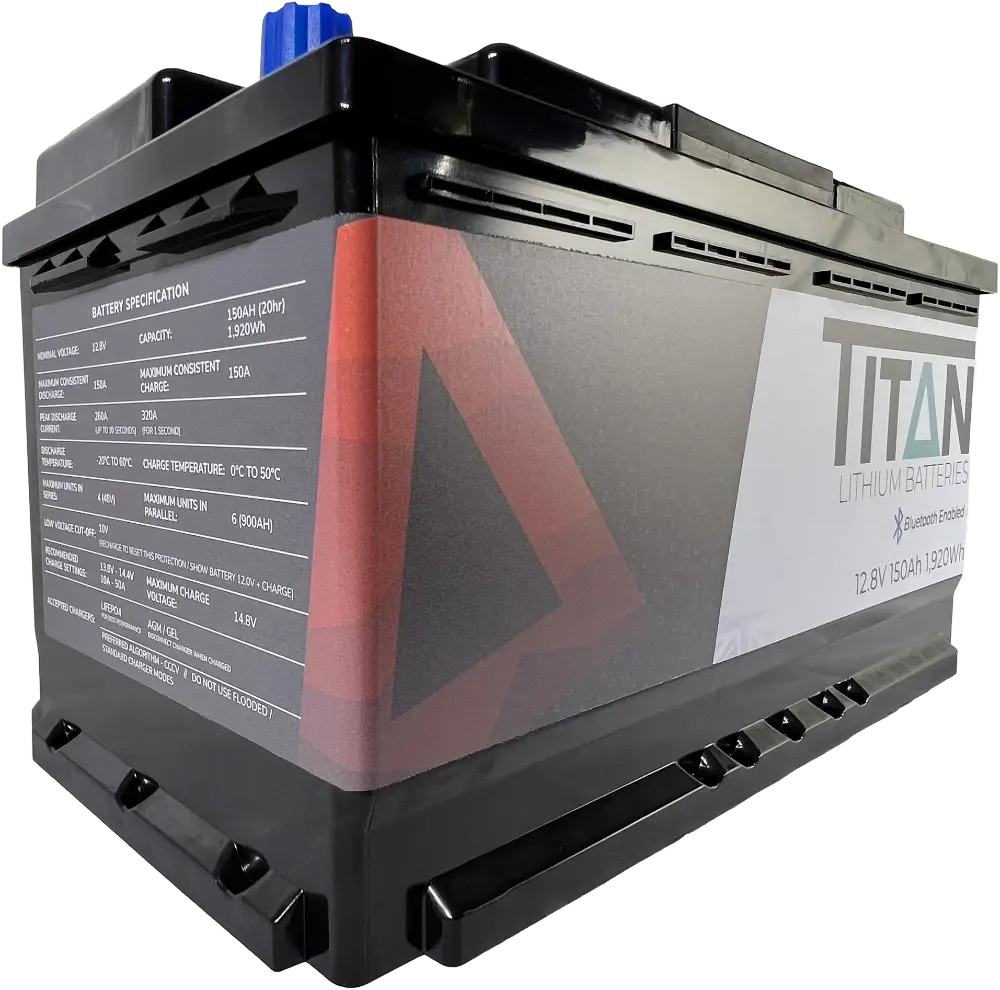
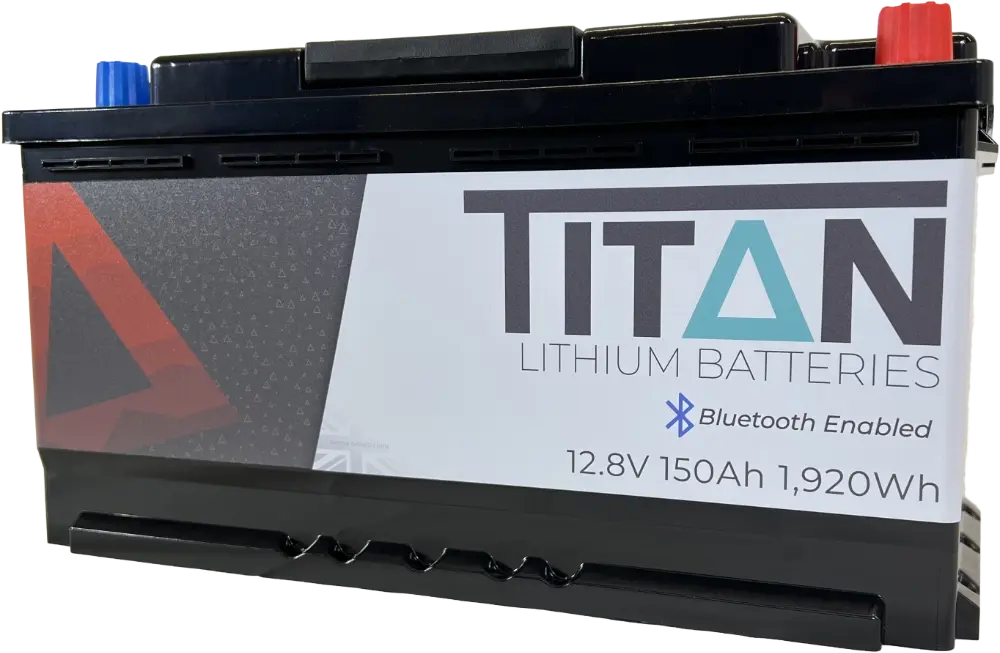
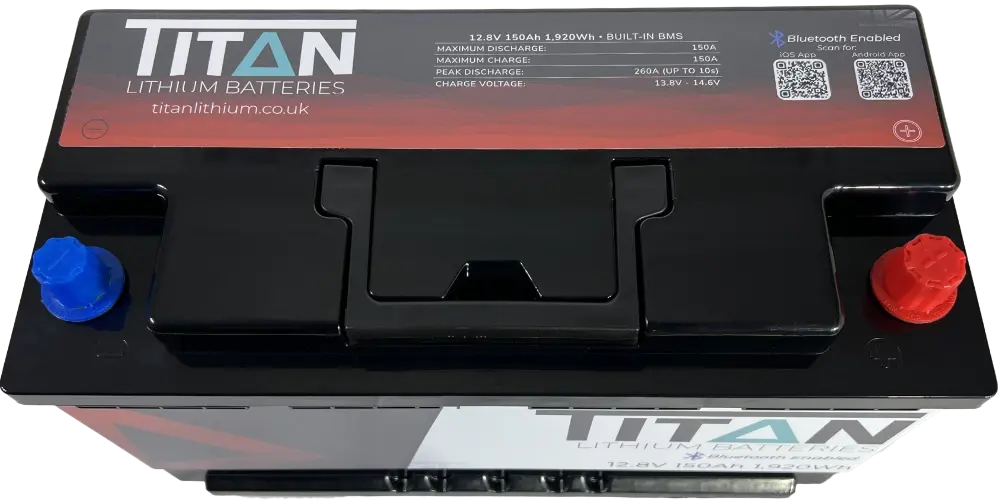
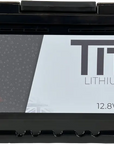
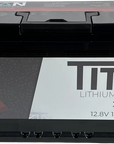
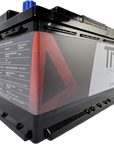
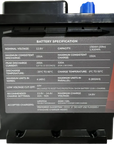
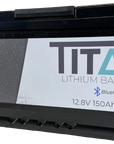
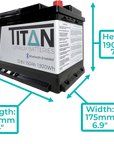
12V High-Density Sprinter & Motorhome Upgrade


12.8V | 150Ah | 1,920Wh
Real achievable capacity - up to 160Ah

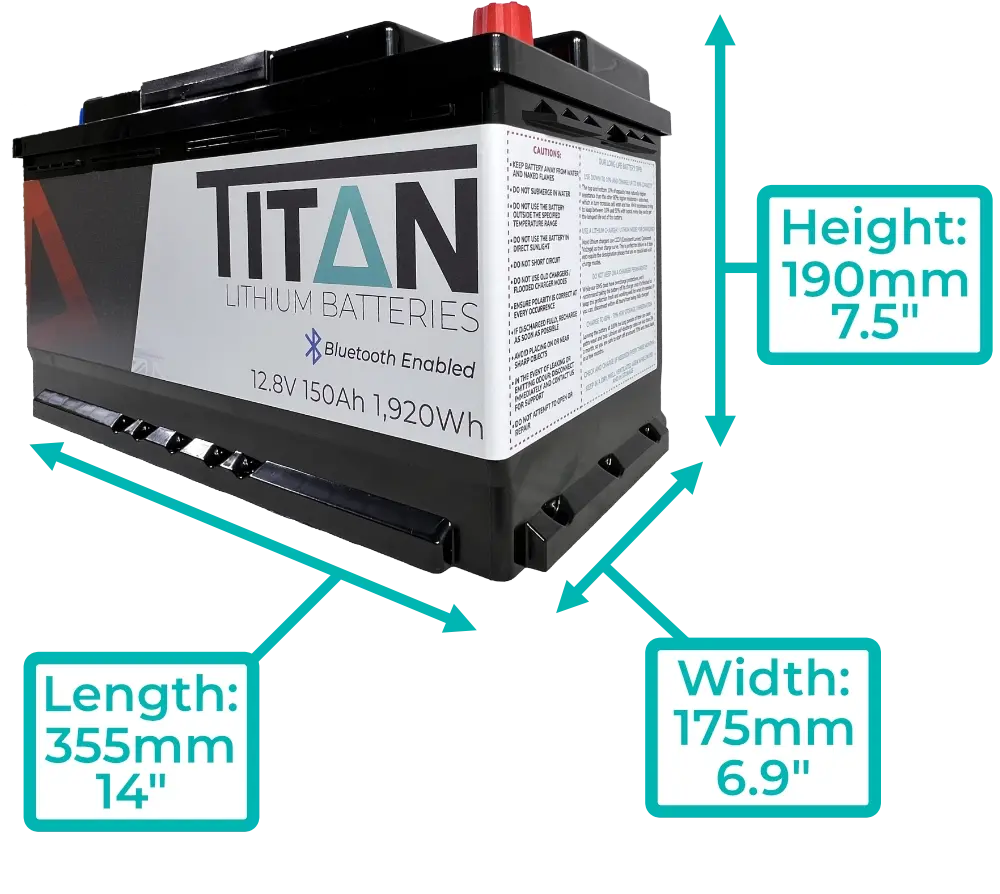
355mm long x 175mm wide x 190mm high
Built for high-density Sprinter and motorhome upgrades - peak capacity in the standard DIN 019 case before stepping up to the 180Ah. Delivers 1,920Wh of real, usable energy at 12.8V with 200A continuous BMS output. The case is an 019 DIN replacement for lead-acid (Varta LFD90, LED95, Banner 95751, Numax DC25MF and friends), so it drops into existing trays without reworking the mount.
Case height is 190mm as standard. It can be mounted on its side to drop overall height to 175mm where fitting space is tight.
| Vehicle Application | Fitment Status | Notes |
| Mercedes Sprinter (Aux) | Direct fit | Replaces factory Aux battery. |
| VW Crafter / MAN TGE | Direct fit | Exact match for factory leisure battery tray. |
| Bailey, Swift, Elddis motorhomes | Direct fit | DIN 019 leisure-battery slot. |
| Ford Transit MK8 | Direct fit | Check length (355mm). Fits most driver seat bases. |
| Rear garage / locker installs | Direct fit | Standard L5 footprint for universal strap-down. |
| Important note | Leisure only | Designed for powering appliances. Not a starter battery. |
| Dimensions | 355mm (L) | 175mm (W) x 190mm (H) |
All TITAN batteries use lithium iron phosphate (LiFePO4) prismatic cells - the most thermally and chemically stable lithium chemistry available. No cobalt, no nickel, no off-gassing, no acid. The trade-off is a slightly lower cell voltage (3.2V per cell, 4 cells = 12.8V) and lower energy density than the NMC cells used in EVs. In return, you get lifespans that make NMC look disposable: 3,000 to 25,000 cycles depending on use, against NMC's 1,000 to 2,500.
LiFePO4 is now widely considered safer than lead-acid. Cells can be installed in any orientation (upright is optimum), contain no liquid electrolyte, and are fully recyclable.
A cycle is one full discharge plus one full recharge. Count scales with how deep you take each discharge:
For reference, the best lead-acid gel battery tops out at 350-400 cycles at 80% DoD. A TITAN at the same depth gives 6,000 - roughly 15x the service life.
Our cells are long, flat prisms that fill the rectangular case end to end. Cylindrical cells leave gaps between every cell and are much harder to repair (lots of spot welding), so we pay the extra cost for prismatic and pass the capacity gain back to you. The aluminium cell casing also disperses heat evenly: even at full 200A BMS allowance we measured peak cell temperatures around 45°C, well inside spec (thermal runaway territory doesn't start until around 100°C). Heater mats also work better with prismatic cells - every cell sits against the heating element, rather than only the outer ring of a cylindrical pack.
Matching this 150Ah in lead-acid means three and a half Exide ER550 115Ah batteries paralleled up to 400Ah. One TITAN 150Ah replaces the lot - huge saving in space, weight and cabling, with no gassing so it can live anywhere.
We quote capacity in Wh (Watt-hours) because Ah on its own ignores chemistry. TITAN lithium delivers 100% of rated capacity. Gel manages around 90%, AGM 75%, flooded lead-acid 60%. Factor that in and a TITAN 150Ah has more than double the real-world capacity of a lead-acid battery on the same label rating.
The closest single lead-acid battery (Exide AGM EP2100 (200Ah AGM)) weighs 65kg and takes around three times the physical volume. A 49kg saving matters on a motorhome's drive-axle plate, at the ferry scales, and at the pump.
Almost every watt you put in comes back out. A great partner for solar - no wasted incoming charge - and happy to accept very high charge currents: 0 to 95% in under two hours at 100A+.
The battery management system is the circuit board between the cells and the terminals. It's the difference between a lithium battery that lasts 15 years and one that self-destructs in two. Most brands fit an off-the-shelf board with generic parameters. We don't.
Our BMS is custom, with parameters tuned to the exact cell spec we use. That lets us run the cells right up to their real safe working limits without compromising protection. It's also how we pull an extra 5-10% usable capacity out of every cell (a 150Ah can show as 160Ah fully charged). We can't guarantee the bonus capacity batch to batch, but the BMS re-maps its 100% reading automatically so the app always shows what you actually have.
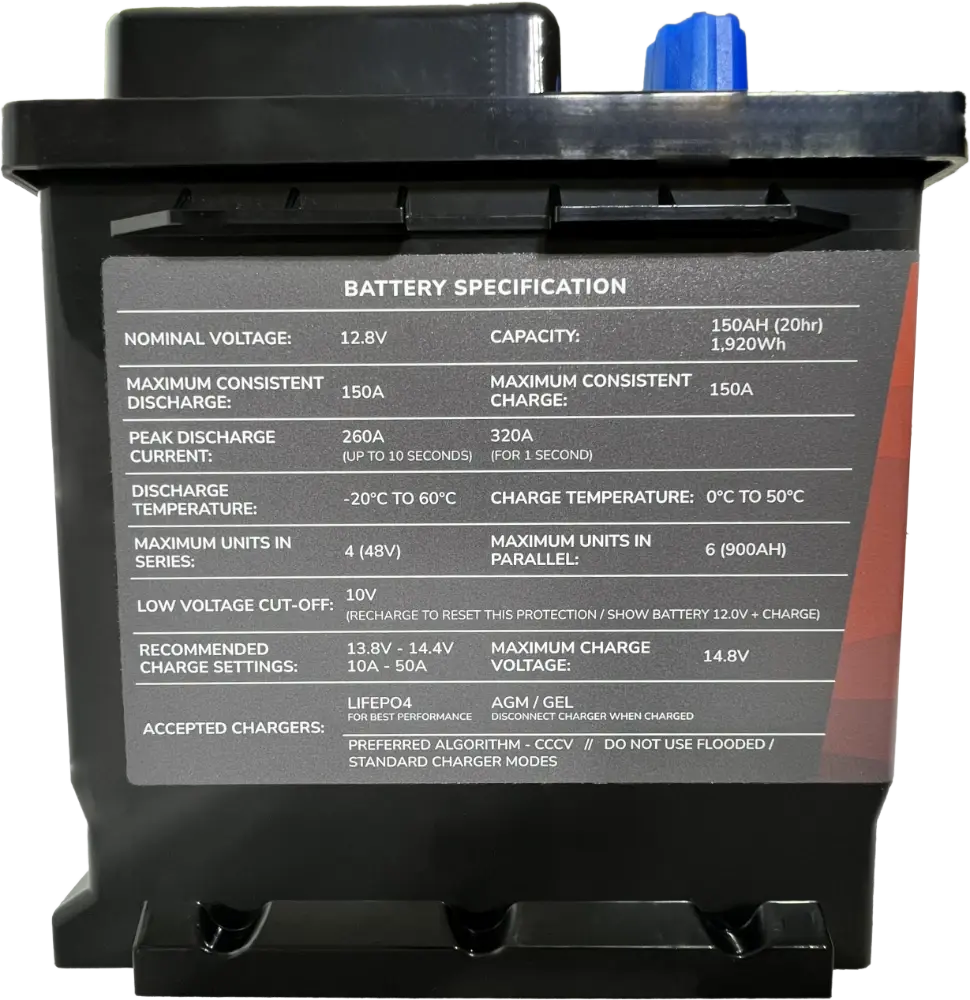
Over-discharge, over-voltage, under-voltage, over-current, short-circuit, over-temperature, under-temperature, cell balance faults and more. All protections are temporary - they either self-reset or clear the moment the battery is put back on charge. The 200A continuous current allowance on this model is class-leading thanks to premium MOSFETs, oversized heat sinks and properly sized internal cabling.
Passive balancing is cheap: cells bleed off to each other and that's it. Active balancing actively moves energy between cells, protecting the weakest cell from doing all the work. Most brands pick one. We run both - passive for small voltage deltas, active for larger ones. Keeps the BMS's own power draw low while still giving you the full benefit of active balancing. It's automatic, most active when charging above 3.4V per cell, and takes full effect between 90-100% SOC.
Lithium cannot be charged below 0°C without cell damage. Our built-in heater mat wraps the internal pack and kicks in automatically at around 2°C whenever there's an incoming charge current. It draws from the charger first, and if the charger can't keep up, pulls up to 3.6A from the battery itself to get cell temperature to 10°C before routing charge back to the cells. Expect roughly 20 extra minutes on your charge time in the cold. Discharge is unaffected and works down to -20°C.
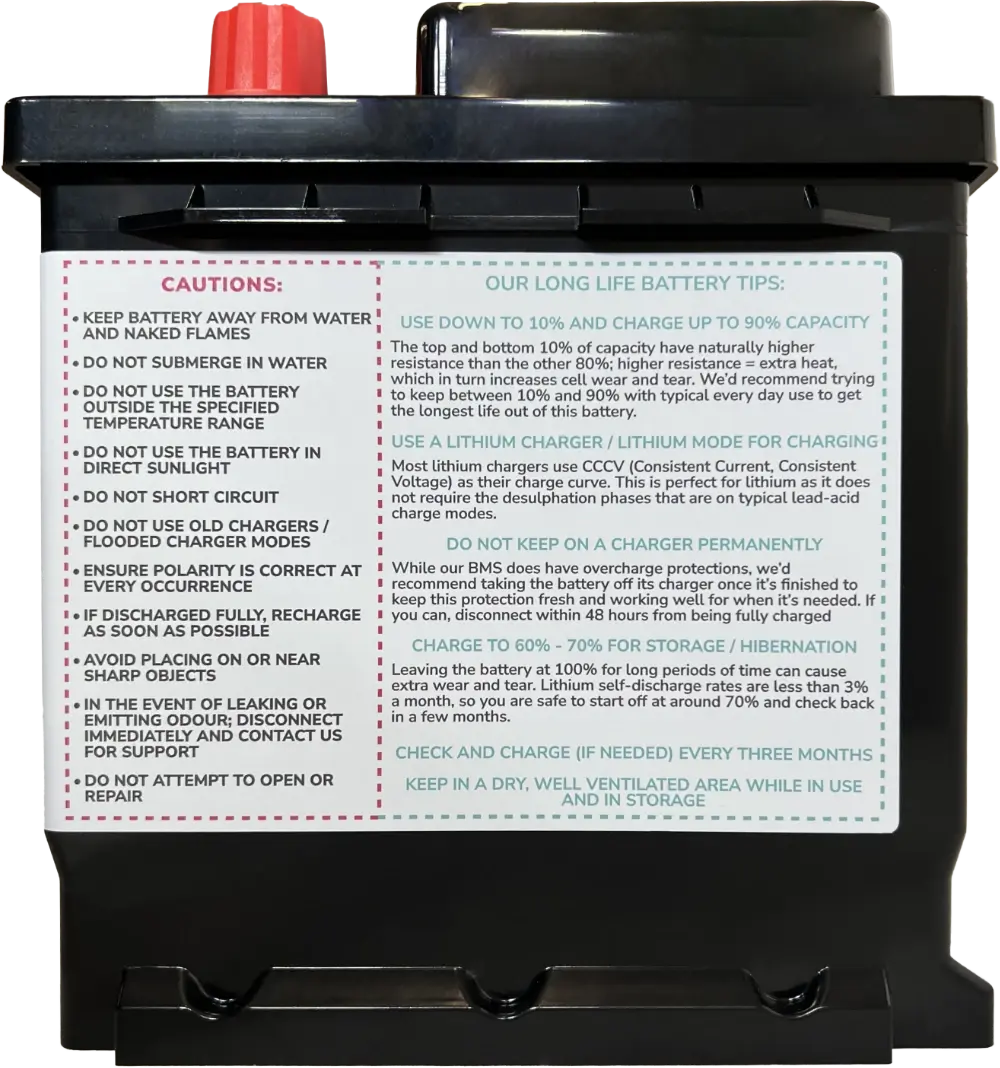
A fully discharged lithium battery left for months can be a lithium battery that doesn't come back. Two hibernation modes keep that from happening:
Inverters, water pumps, motor movers and compressors can pull 1,000A+ for a microsecond on start-up. Many BMSs read that as a short circuit and trip. Ours is tuned to ride those spikes without nuisance shutdowns, so start-up loads behave the way they did on your old lead-acid.
Comms ports on the case let the battery talk to compatible inverters, chargers and GX devices. Defaults to Victron CANBUS (VE.CAN and BMS.CAN) and is compatible with Victron DVCC out of the box. The data mode can be switched to other brands or protocols on request - flag it in the order notes and our engineers will set it before dispatch.
Known working with:
Cable kits for every protocol are stocked on our store.
Designed as a direct, like-for-like replacement for DIN Type 019 lead-acid batteries. Case, terminal layout and dimensions match the lead-acid spec, so there's no need to rework trays, straps or cable runs.
Double-check your charger. TITAN batteries accept AGM or "Sealed" modes if your charger does not have a dedicated lithium preset. Aim for a maximum charge voltage of 14.4V.
Compatible with split-charge relays and DC-DC chargers out of the box. These are deep-cycle leisure batteries for running equipment - not engine-starting batteries.
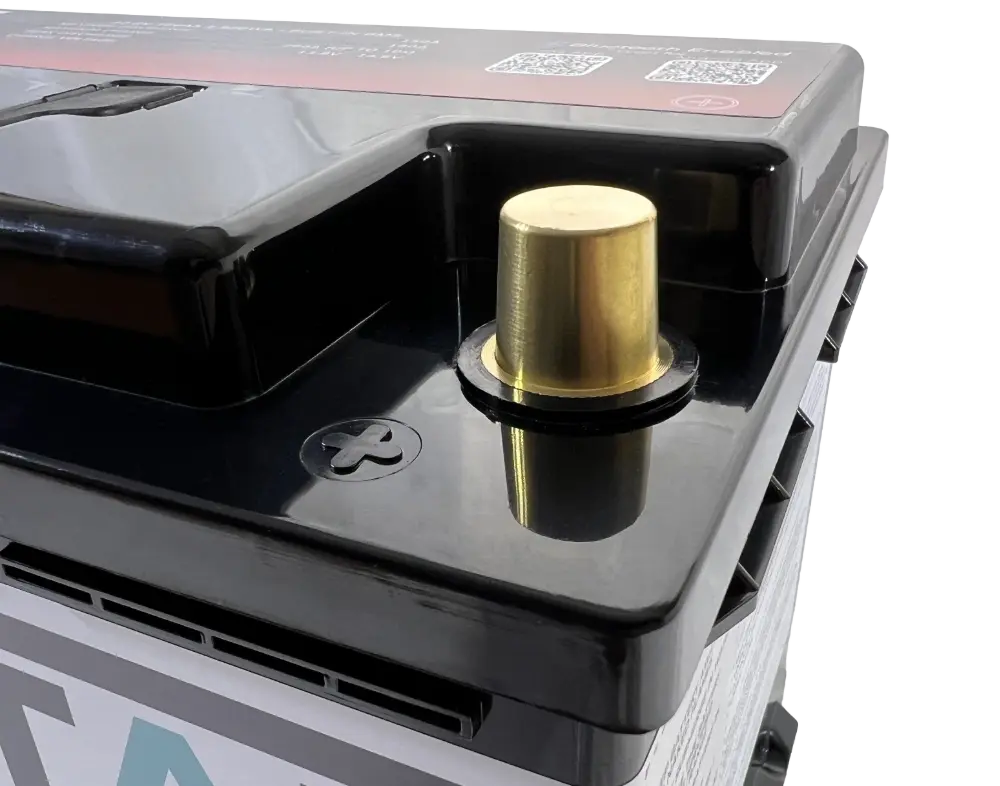
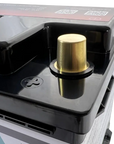
Dual connection as standard: high-performance copper round (SAE/automotive) terminals for lead-acid-style clamp fitment, plus an integrated M8 nut and bolt on the same terminal for direct ring-terminal cabling. No adapters required, corrosion-free contact on both types.
190mm tall as standard - fits under most seat bases and in factory battery trays. Can be mounted on its side to bring overall height to 175mm where needed. Upright is optimal for longevity, but orientation will not affect safety or performance.
Bluetooth is built in. The free TITAN app (iOS and Android, 10 languages) shows live voltage, current in both amps and watts, SOC as a percentage and in Ah, individual cell voltages, internal temperature, estimated time to full or empty, protection trip history and live balancing activity.
It handles multiple batteries in series or parallel and re-calculates totals automatically, so whether you've got one 150Ah or three in parallel, the figures on screen match the actual pack.
We're confident enough in the build to back every grade-A cell battery with a warranty that lasts the lifetime of the battery - fully transferable. Our parent company has been trading continuously since 1948, so we intend to be around to honour it in 20 years' time.
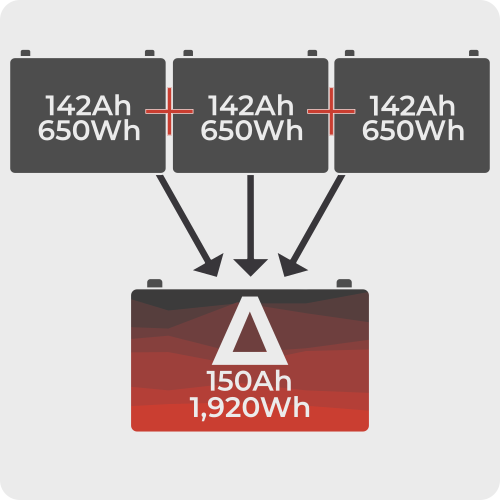
What the warranty doesn't cover is wear. All batteries lose capacity with use - the harder you work them, the faster that happens. LiFePO4 is remarkably resistant: expect a 5-10% capacity drop every decade of normal use. A brand-new 150Ah shows around 160Ah fully charged, a 10-year-old 150Ah around 142Ah, a 20-year-old 150Ah around 130Ah. Natural degradation isn't a valid warranty claim - if a battery stops holding enough capacity for your use, it's time to replace.
The warranty covers components against premature failure caused by manufacturing faults. Full terms are on our warranty page.
The TITAN 150Ah sits at around £550 new. Over its 10-year design life that's £55 a year. The closest lead-acid equivalent - Exide AGM EP2100 - is around £480 with a 4-year design life, which means replacing it roughly 2.5 times over the same period. Call it £120 a year, with cascading labour each replacement. Around £650 saved over 10 years, before you factor in the weight, volume and efficiency benefits. In practice most of our customers see 15-20 years out of a TITAN.
If something fails we repair the failed module - BMS, balance board, a single cell - rather than replace the whole battery. Lower cost to you, lower carbon footprint, faster turnaround. As a family of battery specialists since the 1950s, there isn't much we haven't already rebuilt.
Same usable energy as 3.5× standard 115Ah / 550Wh leisure batteries (we benchmark against the Exide ER550). One TITAN. A fraction of the weight. A custom BMS that handles loads you'd never trust to a flooded leisure battery.
Lead-acid delivers ~40% of its rated Ah in real-world use before damage. TITAN delivers 100%, even at 0% SoC.
~83% lighter for the same usable energy — one DIN-019 TITAN unit instead of 3.5 flooded leisure batteries.
Self-resetting protections, no nuisance trips. Lead-acid? Whatever the cables and cold can take.
Replaces 3–4 standard ER550-class leisure batteries with one DIN-019 TITAN unit. Same case as the Varta LFD90, LED95, Banner 95751, Numax DC25MF, Exide EZ850 (EFB), EP800 (AGM) or ES900 (Gel). One battery, with the usable energy of 3.5 of them.
Comparisons are Wh-based against the Exide ER550 (115Ah / 550Wh / ~26kg) flooded leisure battery — one of the few lead-acid units that publishes a Wh rating. Same DIN-019 case is used by the Varta LFD90, LED95, Banner 95751, Numax DC25MF and Exide EZ850 (850Wh EFB), EP800 (800Wh AGM) and ES900 (900Wh Gel). Lead-acid usable energy assumes ~40–50% depth of discharge and voltage sag under load; TITAN figures assume 100% DoD at the C/5 rating.
Everything that ships with the battery, in writing. Spec sheet for the engineers, install & care manual for everyone else.
Full electrical, BMS, thermal & chemical-safety data — the same numbers our engineers test to.
Install, charge, care & warranty terms — covers every TITAN battery in the current range.
Most lithium leisure batteries are built down to a price. We design ours from the BMS out. Three things every TITAN ships with, no matter the size.
A custom BMS, not an off-the-shelf board. Oversized heat sinks, premium cabling, anti-vibration silicone on every contact, module-based for in-field repair, and our own comms package so no third-party app can edit your parameters.
Read the deep diveEVE and CATL cells, factory-graded for capacity and internal resistance, then top-balanced before assembly. We test every pack on the bench in Cheltenham before it leaves the building.
How we testDIN-format casework so it drops straight in where the lead-acid came out. Marine-spec terminals, an integrated low-temp charge cut-off, and a Bluetooth radio paired to the TITAN App for live monitoring from your phone.
Meet the app| ELECTRICAL SPECIFICATIONS | |
|---|---|
Nominal Voltage: The battery's working voltage
|
|
Capacity: |
|
Energy: Watt-hours is our recommended capacity to use when comparing against other battery chemistries
|
|
Resistance: |
|
Efficiency: How efficient current is used without loss to resistance and heat
|
|
Self Discharge: The standby self-discharge amount without use - all batteries have some level of self-discharge but lithium has one of the lowest
|
|
| PHYSICAL SPECIFICATIONS | |
Dimensions: |
|
Weight: |
|
Terminal Type: |
|
Case Material: |
|
Enclosure Rating: While resistant to water ingress, all batteries should avoid water where possible
|
|
Cell Chemistry: |
|
Cell Type: Lithium batteries can either be made with cylindrical or prismatic cells - cylindrical is cheaper and easier to make while prismatic is more efficient with space so can offer larger capacities
|
|
| TITAN BMS SPECIFICATIONS | |
Consistent Discharge: Maximum amount of amps you can pull from this battery for an unlimited time (until it goes flat)
|
|
Peak Discharge: The absolute maximum amount of amps this battery can output over the consistent discharge rating for a period of time
|
|
Maximum Charge Rate: |
|
Low Voltage Charge: Battery nearing 0% - charge at this voltage
|
|
Low Voltage Disconnect: The battery will switch off discharging at this voltage. The battery will need to be charged ASAP at this point
|
|
Short Circuit Protection: This protection triggers should a short circuit occur. We use a maximum amp rating and how fast it triggers (the faster the better)
|
|
Recommended Charge Rate: Based on average consumer charge ratings and time to charge
|
|
Recommended Charge Voltage: |
|
Maximum Charge Voltage: |
|
Maximum Connections: |
|
Discharge Temperature Range: |
|
Charge Temperature Range: |
|
| HEATER SPECIFICATIONS | |
Heater Activation: |
|
Heater Power Source: |
|
Heater Target: |
|
Heater Consumption: |
|
| CELL BALANCING SPECIFICATIONS | |
Cell Balance Method: |
|
Active Balance Activation: |
|
Passive Balance Activation: |
|
| COMMUNICATION SPECIFICATIONS | |
Default Set Protocol: |
|
Victron DVCC Compatible: |
|
Other Compatible Protocols: |
|
Battery Parallel Communication Via: |
|
| In The Box | |
Included: |
|
| Downloads | |
 Datasheet Datasheet |
|
 User Manual User Manual |
|
| Safety & Compliance | |
 Type Approvals: Type Approvals: |
|
 Short Circuit Test: Short Circuit Test: |
|
 Over Charge Test: Over Charge Test: |
|
 Over Discharge Test: Over Discharge Test: |
|
 Altitude Simulation: Altitude Simulation: |
|
 Thermal Test: Thermal Test: |
|
 Vibration Test: Vibration Test: |
|
 Shock Test: Shock Test: |
|

