


The diagram
Battery, protection, busbars, chargers, solar, inverter and loads, with every cable drawn terminal to terminal and crossings clearly marked.
Buying a TITAN battery and want to see how the whole system goes together? Tell us what else is going in and our technical team will draw it up: every battery, fuse, busbar, charger and load, with a cable schedule your installer can work from.
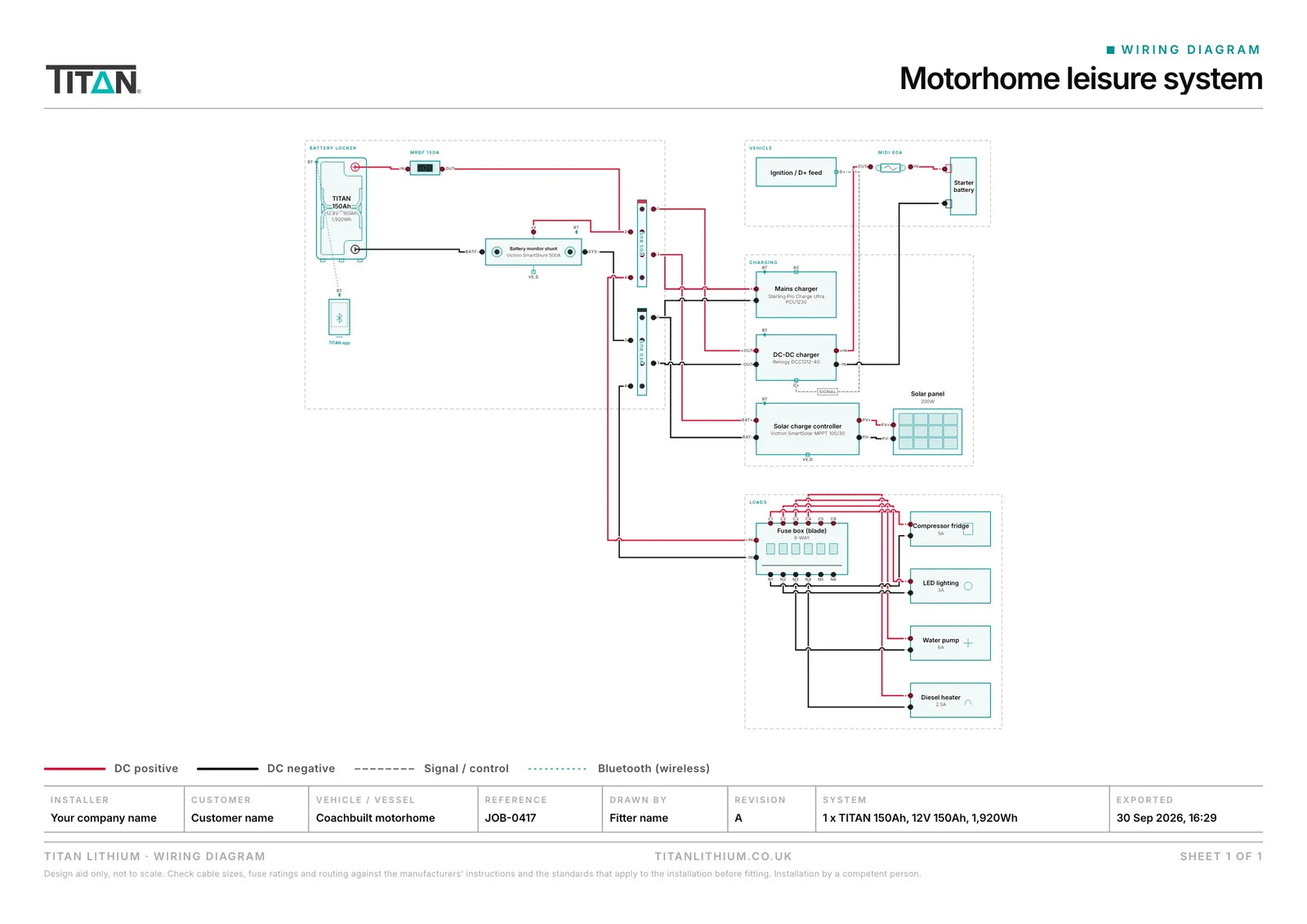
An A4 or A3 PDF built around your TITAN battery, in the same format our trade partners hand over on their own installs.
Battery, protection, busbars, chargers, solar, inverter and loads, with every cable drawn terminal to terminal and crossings clearly marked.
Each power run listed from and to, with cable size, length, current and voltage drop. It runs over as many sheets as it needs, so nothing is cut short.
The batteries, fuses, busbars and hardware on the drawing, so you know what is needed before the day of the install.
Cable sizes, fuses, voltage drop, battery fusing and motor loads, each flagged with the reason and a suggested fix. More on the checks below.
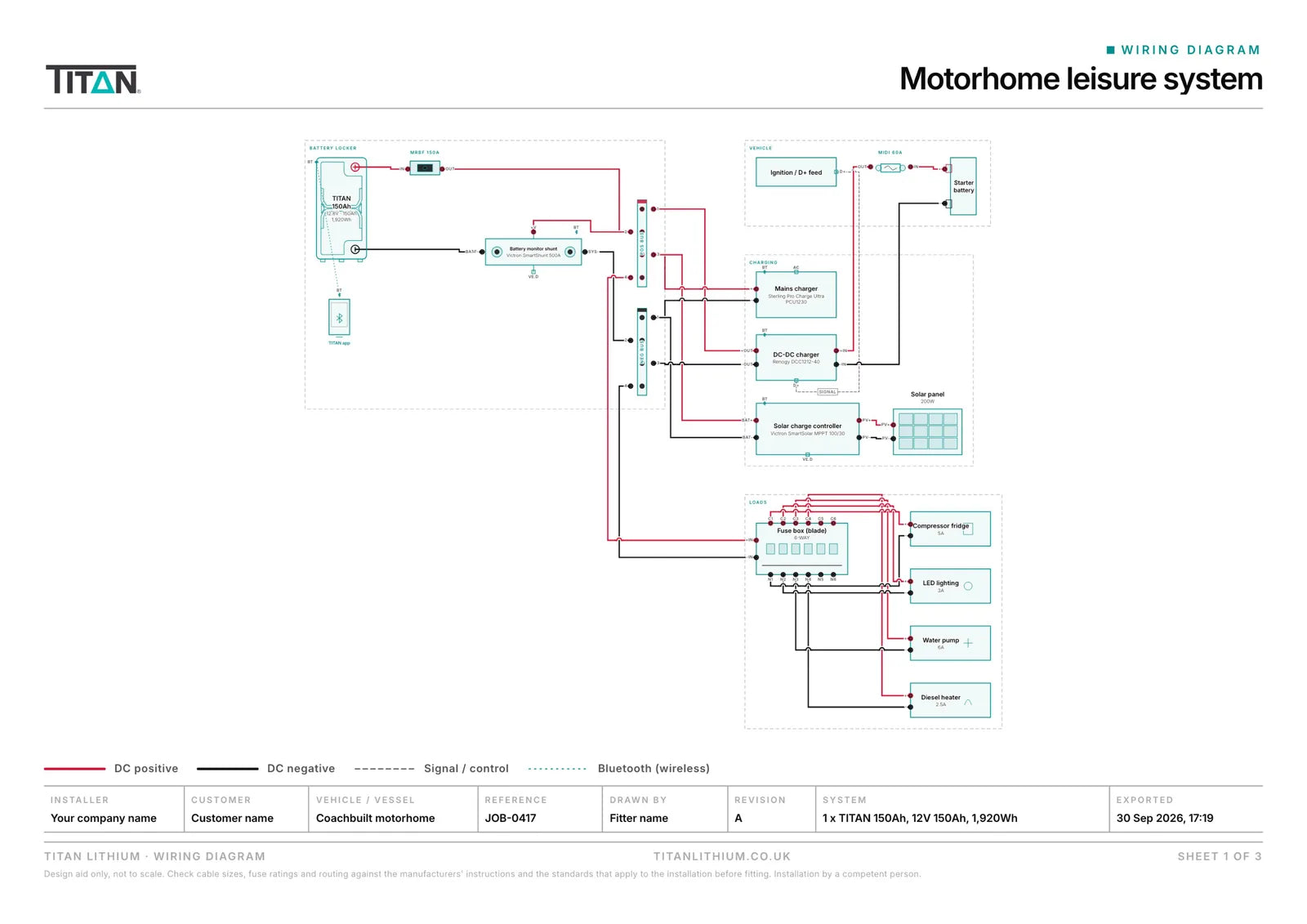
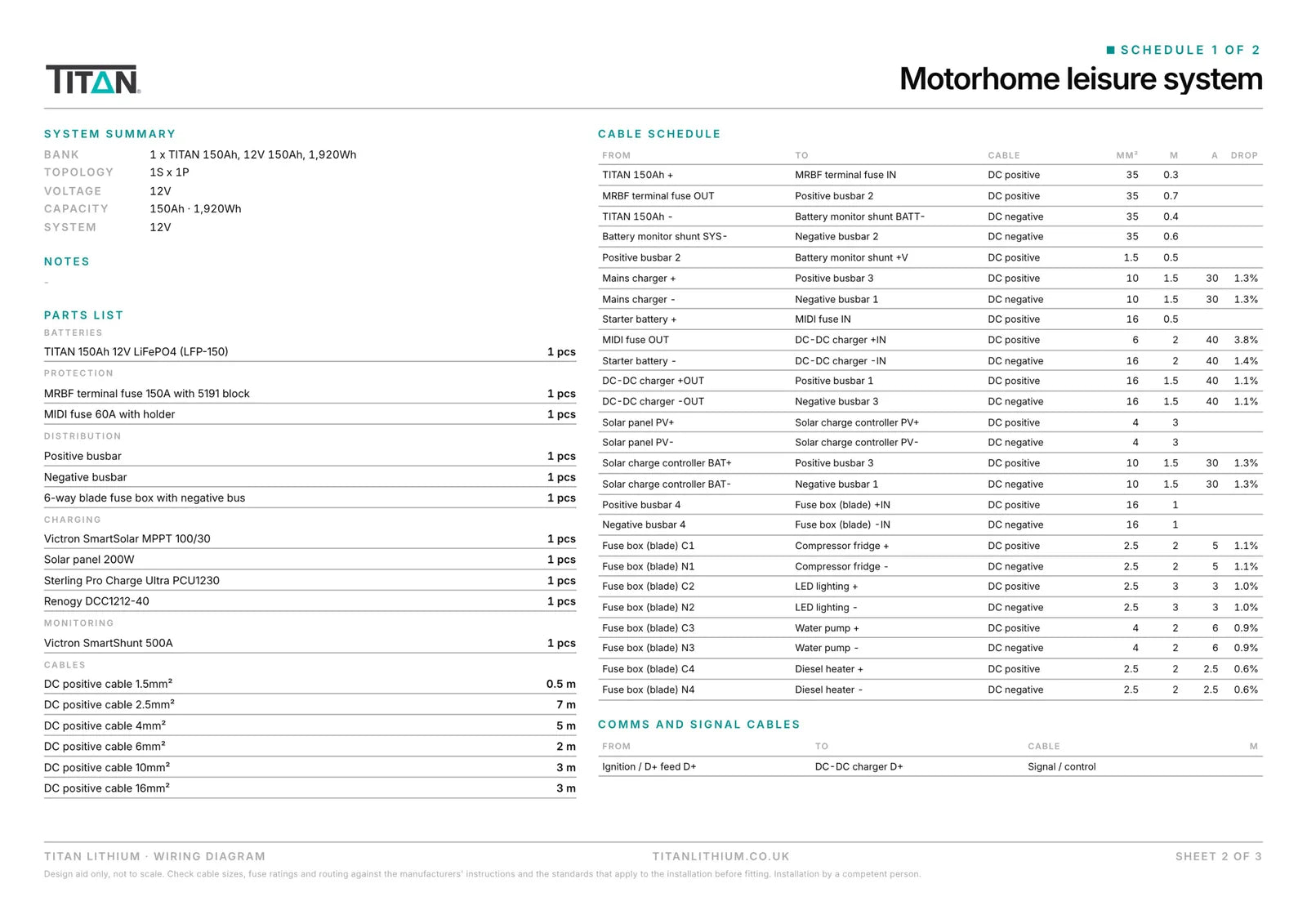
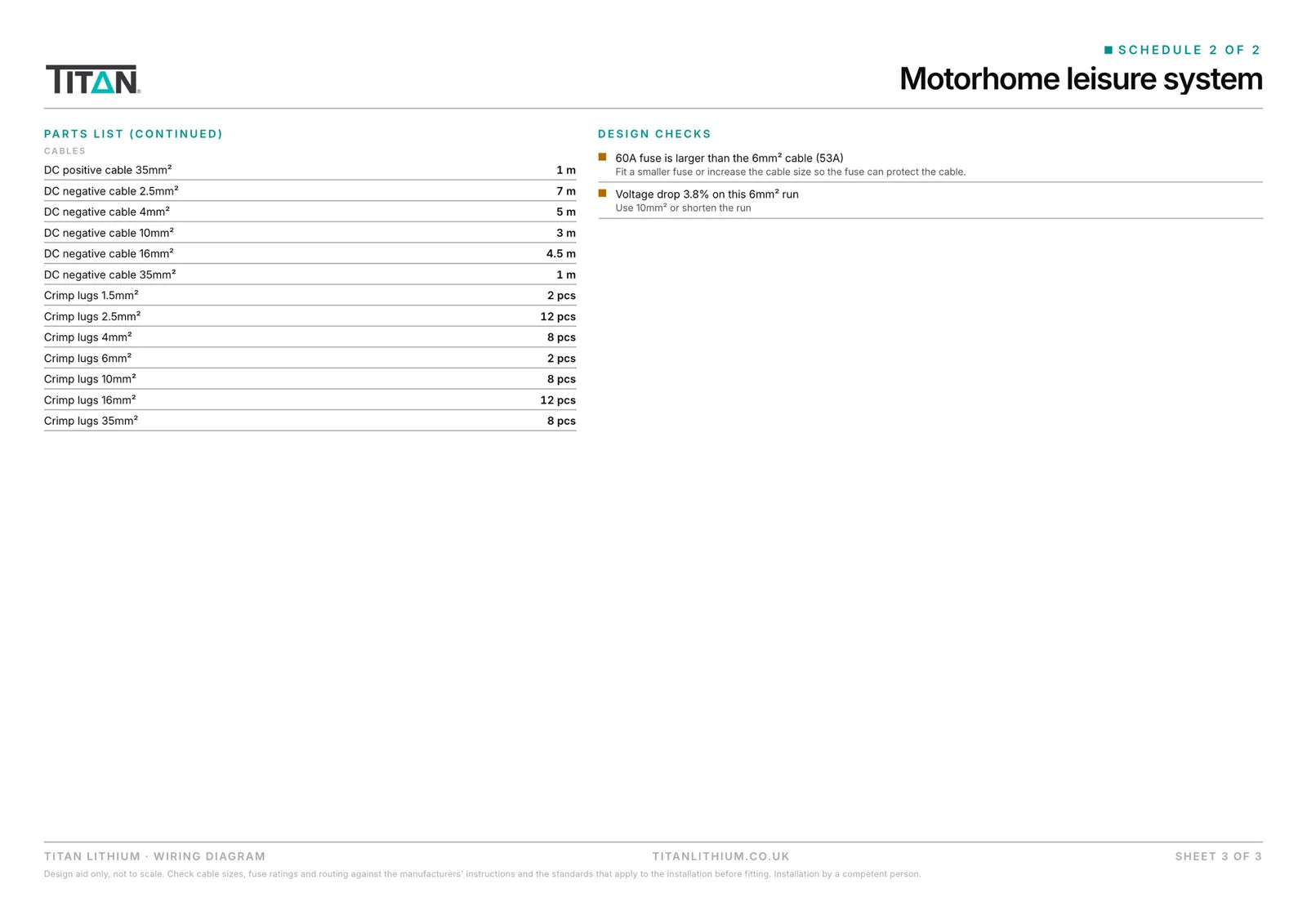
A sample export from the TITAN wiring designer, printed on A4. Exports are vector PDFs, so lines and text stay sharp when you zoom in or print at A3. Select a sheet to see it full size.
Every drawing runs through the same checks as it goes together. Each one that flags comes with the reason and a suggested fix.
Every run is checked against the current it carries. Above a conservative rating it asks for the figure on the cable's datasheet. Above what battery cable makers publish, it is a warning with the next size up.
A fuse protects the cable, so it must not be rated above what that cable can carry. Every inline fuse, and every way on a fuse box or Lynx, is checked against the cable it feeds.
A way fused below what its device draws will blow in normal use, and a fuse above the maker's stated maximum no longer protects the device. Both are flagged.
Lithium can deliver a very high short-circuit current, so each battery positive needs a high-interrupt fuse such as an MRBF or Class T within 175mm of the post. A battery without one is flagged.
Long, thin runs starve chargers and loads. Each run is checked against a 3% limit, or 10% for short-duty motors, and the drawing suggests the cable size that brings it back in.
These motors pull very high current for a few seconds at a time. Their peak is checked against the battery's continuous BMS rating, and their cables and fuses against the maker's own figures where they are published.
Batteries only share a load evenly when their cable runs match. For big motor loads the designer estimates each battery's share from its runs and flags one that would be pushed past its BMS rating.
Reversed polarity, shorts, devices with one terminal connected, mixed models or voltages in parallel, 12V parts on a 24V system, and TITAN comms wired to the GX with the wrong lead.
Warnings need sorting before the install. Information notes mark things worth confirming, such as a cable running near the top of its range, where the cable maker's datasheet has the final say.
The vehicle or boat, your TITAN battery, and the make and model of every charger, solar controller, inverter and main load. Photos of the existing setup help.
Our technical team lays the system out in the TITAN wiring designer and works through the checks, usually within 1-2 working days of having the full details.
A print-ready drawing with the cable schedule and parts list, ready to keep with the vehicle or boat.
Work from it yourself or pass it to your installer. Either way, the installation should be carried out or checked by a competent person.
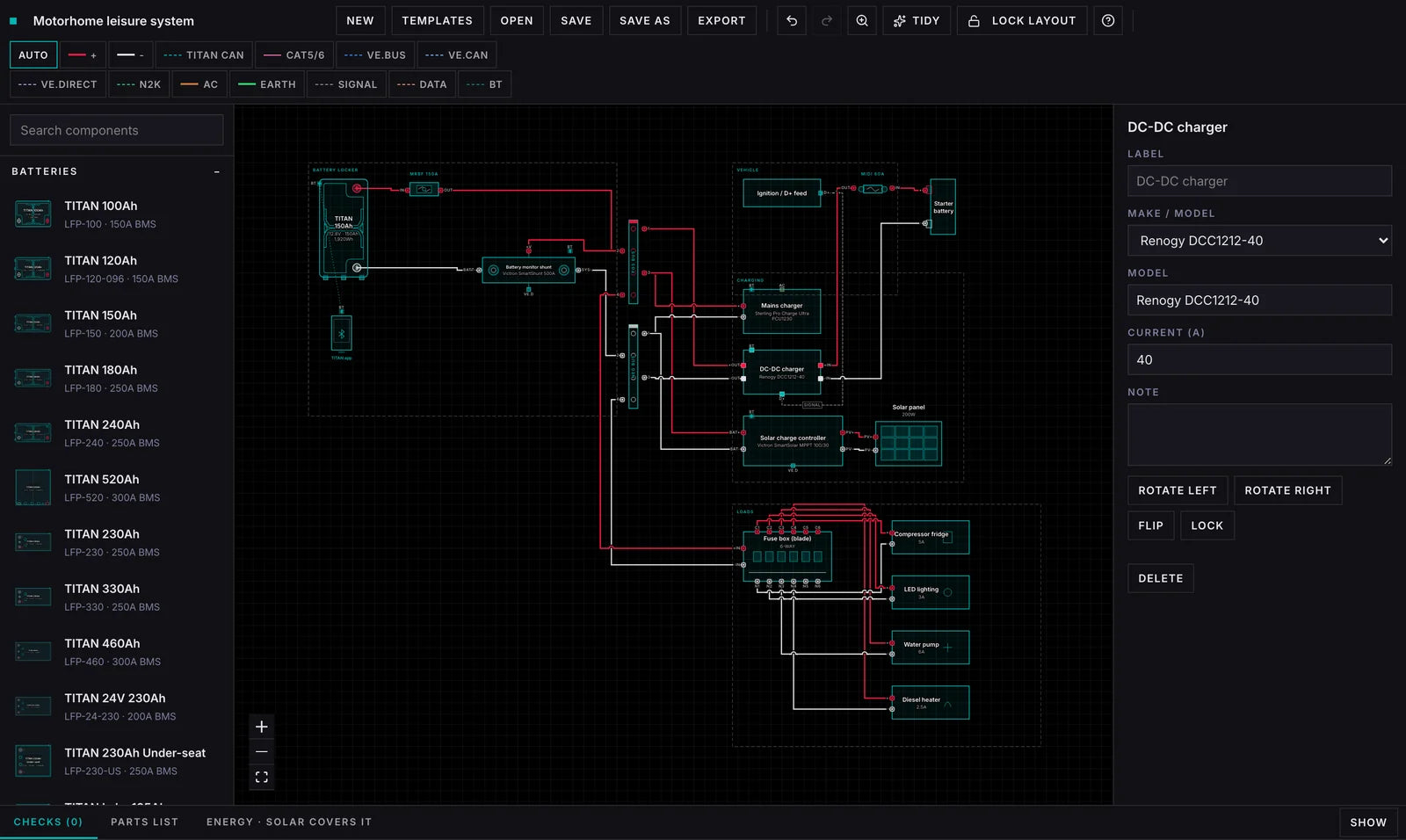
The TITAN wiring designer was designed and built in Cheltenham for our trade partners, who use it in the trade portal to plan installs and hand over drawings with their own company name on them. Our technical team uses the same tool to draw up systems for TITAN customers.
It is not limited to Victron. The library below covers charging, distribution, motors and marine kit from the main makers, and anything else goes in as a custom device with its own rating.
A fuse dropped onto a cable splits it in two, and the run can be measured end to end or section by section, so a cable bought to length stays one figure on the schedule.
Pick a make and model and its ratings fill in from the maker's own figures, so the checks start from the right numbers.
Mains chargers, DC-DC chargers, solar controllers, inverters and monitors from Victron, Renogy, Sterling, Votronic, CTEK, Redarc, EPEver, Schaudt, Mastervolt, Sargent, Apuljack, PV Logic and CBE.
Victron Lynx, Blue Sea SafetyHub and MRBF blocks that bolt to the battery post, busbars, and fuse boxes from Blue Sea, BEP, Durite, Sterling and Votronic with a rating on every way. Class T, MEGA, ANL and MIDI fuses.
Motor movers from Powrtouch, Truma, Reich and AL-KO, and hydraulic levelling from E&P Hydraulics, each with its running and peak current.
Bow and stern thrusters from Vetus, Side-Power, Lewmar and Max Power, Lewmar windlasses, and NMEA 2000 networks, with the maker's current and fuse figures for each model.
Trade partners draw their own diagrams in the TITAN trade portal, with the same checks, one-click Tidy to lay out a busy system and their company name on every sheet.
A wiring diagram shows how the system should go together and flags common mistakes. It does not replace the manufacturers' instructions, the standards that apply to your vehicle or boat, or a competent installer checking the finished work.
It is for systems built around a TITAN battery, whether you are fitting it yourself, having it fitted, or upgrading from lead-acid. Send us the details using the form below.
As much detail as you can give, because the drawing is only as accurate as the kit list behind it. The vehicle or boat, which TITAN battery you have or are buying, the make and model of each charger, solar controller and inverter, and the main 12V loads. Rough cable run lengths let us check cable sizes and voltage drop properly.
Usually 1-2 working days once we have the full details. If a make, model or rating is missing we will ask before we draw, so sending everything up front is the quickest route.
Yes. The designer has make and model presets for Victron, Renogy, Sterling, Votronic, CTEK, Redarc, EPEver, Schaudt, Mastervolt, Sargent, Apuljack, PV Logic and CBE, and anything else can be added as a custom device with its rating.
Yes. Every power cable is checked against the current it carries, every fuse against the cable it protects, and longer runs for voltage drop. A battery positive without a high-interrupt fuse at the post is flagged, and so is a motor load that peaks above the battery's BMS rating. Each warning comes with a suggested fix.
Yes. Movers from Powrtouch, Truma, Reich and AL-KO, thrusters from Vetus, Side-Power, Lewmar and Max Power, and Lewmar windlasses are in the library. These motors draw very high current for a few seconds, so their peak is checked against the battery's BMS rating, and on a bank of batteries in parallel the drawing estimates how the load shares between them.
No. It is a design aid. It shows how the system should be wired and flags common mistakes, but ratings still need checking against the manufacturers' instructions and the standards that apply, and the installation should be carried out or checked by a competent person.
The designer is available to TITAN trade partners through the trade portal. Installers can apply for trade access. Owners can ask us to draw their system instead.
The more detail you send, the more accurate the drawing. Include your TITAN battery (or order number), the vehicle or boat, and the make and model of everything else going in: chargers, solar, inverter and the main loads. Diagrams usually come back within 1-2 working days.

